1. Introduction
1.1. Aspectran Framework Overview
Aspectran is a lightweight, high-performance application framework built on the JVM, meticulously engineered to span a wide spectrum of computing workloads—from simple command-line tools (CLI) to high-throughput asynchronous microservices and traditional enterprise web applications.
This document presents the overarching system architecture blueprint of Aspectran. Moving beyond isolated descriptions of individual components, it provides a holistic perspective on how the framework’s layered components synergistically assemble to process requests, guarantee environmental independence, and establish an end-to-end execution model.
1.2. Core Design Philosophy and Principles
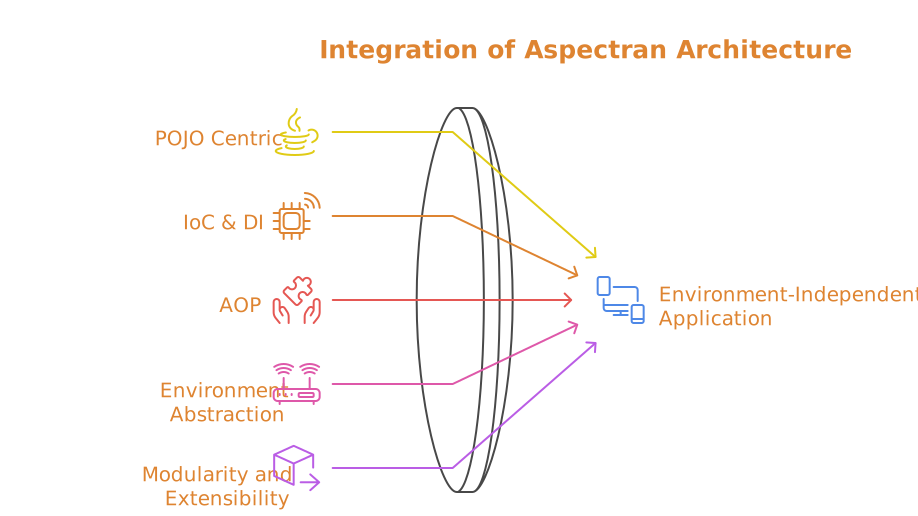
Aspectran’s architecture is anchored in the following foundational design principles:
- POJO (Plain Old Java Object) Centric: Ensures business logic remains uncontaminated by framework-specific interfaces. Developers implement business functionality as pure Java objects, while the framework composes them through declarative rules.
- IoC (Inversion of Control) and DI (Dependency Injection): The framework engine governs the instantiation, configuration, and lifecycle of objects, utilizing constructor, field, and method injection to minimize coupling and maximize unit testability.
- Seamless AOP (Aspect-Oriented Programming) Integration: Cross-cutting concerns (security, transactions, logging, profiling, etc.) are physically decoupled from core business logic. Runtime dynamic proxies intelligently weave advice with minimal overhead.
- Complete Environment Abstraction: Extensively adopts the Adapter pattern to isolate technological differences across diverse execution environments (servlet web, non-servlet network servers, console shells, background daemons). Business logic operates completely unaware of its underlying runtime.
- Micro-Modular Architecture and Diverse Runtimes: Assembles only necessary capabilities (Servlet, Netty, Undertow, Jetty, session stores, etc.) as modular plug-ins on top of a minimal core, delivering an ultra-lightweight and fast runtime footprint.
1.3. Layered System Architecture Model
The entire Aspectran architecture is organized into five distinct logical layers with well-defined responsibilities:
- Service & Server Runtimes Layer: Acts as the entry point for external requests and manages the lifecycle of the host execution environment (Servlet, Netty, Undertow, Jetty, Shell, Daemon, Embed).
- Environment Abstraction Layer (Adapters): Normalizes runtime-specific I/O constructs (
HttpServletRequest, Netty channels, UndertowHttpServerExchange, console streams, etc.) into unified Aspectran standard interfaces. - Execution Engine Layer (Activities & Translets): Orchestrates the request processing flow, executes business actions and translet rules, and collects execution results.
- Core Container Layer (Context & Rules): Centered around
ActivityContext, this layer oversees bean lifecycles, AOP rules, translet blueprints, and system environment configurations. - Infrastructure & Utilities Layer: The foundational utility suite supporting the entire framework, including
SiblingClassLoader(dynamic reloading),nodelet(lightweight streaming parser), PBE encryption, and unified logging (SLF4J/Logback).
2. Service Architecture and Diverse Execution Environments
2.1. Foundation of the Service Container: CoreService
In Aspectran, a Service is the fundamental operational unit that governs the framework engine’s lifecycle and serves as the container for a specific execution environment.
2.1.1. Top-Level Abstraction: CoreService and DefaultCoreService
The CoreService interface in com.aspectran.core.service defines the top-level contract for all Aspectran services.
- Role: Controls the entire lifecycle (
ServiceLifeCycle), including starting (start), stopping (stop), pausing (pause), and resuming (resume). It acts as the standard bootstrapper responsible for instantiating and initializingActivityContext—the central hub of all framework components. - Standard Implementation:
DefaultCoreServiceloads configuration files (AspectranConfig), builds the context viaActivityContextBuilder, registers a singleton file lock (FileLocker) to prevent duplicate process instances, and hooks into JVM shutdown (ShutdownHook). - Service Registry: Every active service is safely registered in the global
CoreServiceHolder, allowing context and service lookups from anywhere across the application.
2.1.2. Feature Extension Module: SchedulerService
SchedulerService is a sub-service that operates subordinately to the lifecycle of its parent service (CoreService).
- Scheduling Abstraction: Reads
ScheduleRuledefinitions from the Aspectran configuration and drives a Quartz scheduler instance in the background. - Execution Integration: When a schedule interval triggers, the Quartz job
ActivityLauncherJobexecutesJobActivity, a specialized activity dedicated to background scheduled tasks. - Distributed Locking Support: Integrates
ScheduledJobLockProviderto enforce precise distributed execution locks, preventing duplicate task executions in multi-node clusters.
2.2. Analysis of Diverse Runtime Environments
Aspectran employs a granular, modular structure on top of a single core engine, allowing developers to flexibly select the ideal runtime matching infrastructure requirements.
2.2.1. Modern Separation of Web Environments: aspectran-web vs aspectran-web-servlet
Aspectran’s web architecture is cleanly bifurcated into a pure web abstraction module and a servlet specification binding layer:
- Pure Web Abstraction Layer (
aspectran-web):- A pure web module completely independent of servlet APIs (
jakarta.servlet.*). - Provides foundational infrastructure common to all web environments, including HTTP request parsing and parameter binding (
WebRequestBodyParser,RequestHeaderParser), internationalization (AcceptHeaderLocaleResolver), standardized REST response encapsulation (RestResponse,ResponsePayload), and CORS processing (DefaultCorsProcessor).
- A pure web module completely independent of servlet APIs (
- Standard Servlet Integration Layer (
aspectran-web-servlet):- Integrates Aspectran into standard Java Servlet/Jakarta Servlet container environments (Tomcat, Jetty, external WAS deployments).
- Primary Entry Points: Servlet lifecycle listener
WebServiceListenerand HTTP routing servletWebActivityServlet. - Core Components:
ServletWebService(implemented byDefaultServletWebService), servlet request executorServletWebActivity, and servlet request wrapperActivityRequestWrapper.
2.2.2. Servlet-Free High-Performance Network Engine: Netty Environment (with-netty)
A servlet-free runtime engineered for modern high-performance microservices and asynchronous event-driven networking.
- Purpose: Eliminates servlet container overhead by connecting Aspectran’s translet processing engine directly onto Netty’s non-blocking I/O (NIO) pipeline, delivering minimal memory footprints and ultra-low latency. It is also optimized for Java Virtual Threads.
- Primary Entry Points and Components:
NettyServer(implemented byDefaultNettyServer): Bootstraps Netty’sServerBootstrapand channel pipelines.NettyService(implemented byDefaultNettyService): The specializedCoreServicecoordinating with the Netty server.NettyActivity: DedicatedActivityhandling inbound Netty HTTP requests.
2.2.3. Lightweight Embedded Web Server: Undertow (with-undertow)
An execution environment based on JBoss Undertow, a high-performance, lightweight web server.
- Purpose: Delivers a high-throughput embedded web runtime allowing flexible composition of blocking and non-blocking handler chains.
- Key Components:
TowService(implemented byDefaultTowService): Service governing the Undertow runtime.TowActivity: Directly wraps Undertow’s nativeHttpServerExchangeto dispatch requests at maximum speed.
2.2.4. Embedded Servlet Web Server: Jetty (with-jetty)
Embeds a standard servlet container directly into the application for familiar and lightweight operations.
- Purpose: Bootstraps Eclipse Jetty as an embedded servlet engine, maintaining standard servlet compatibility within standalone (fat JAR) web deployments.
- Key Components: Configures
ServletContextHandlerviaJettyServerand mountsWebServiceListenerfor bootstrapping.
2.2.5. Interactive Console (CLI) Environment: Shell (aspectran-shell)
An interactive command-line interface environment interacting with users via terminal consoles.
- Primary Entry Point:
AspectranShell.main(), which internally governs the console lifecycle viaDefaultShellCommander. - Key Components:
ShellService(implemented byDefaultShellService)ShellActivity: Maps command-line arguments and standard I/O streams to activity executions.ShellConsole: Abstraction layer managing JLine terminals and standard console I/O.
2.2.6. Background Process Environment: Daemon (aspectran-daemon)
A headless background server process environment designed for continuous execution without a direct user interface.
- Primary Entry Points:
DefaultDaemon,ProcrunDaemon(for Windows Services),JsvcDaemon(for Linux/Unix Daemons). - Key Components:
DaemonService(implemented byDefaultDaemonService)DaemonActivityCommandExecutor,FileCommander: Asynchronously receives external control commands via file watching or polling queues to trigger translets.
2.2.7. Embedded Library Environment: Embed (aspectran-embed)
Embeds the Aspectran engine as an in-process library within existing Java applications or unit tests.
- Key Components:
EmbeddedAspectran(implemented byDefaultEmbeddedAspectran): A high-level facade API providing intuitive calls totranslate(),render(),execute(), andgetBean().AspectranActivity: Specialized lightweightActivitydesigned for programmatic invocations.
🔍 Related Detailed Mechanisms
For deeper insights into service lifecycles, bootstrapping sequences, and runtime entry points, refer to Aspectran Service Architecture In-Depth and Aspectran Execution Environments In-Depth.
3. Environment Abstraction: Adapter Architecture
One of the most distinctive strengths of Aspectran’s architecture is its thorough adoption of the Adapter pattern. Adapters abstract the distinct I/O and session mechanisms of diverse runtimes, completely decoupling business logic (Translets and Beans) from physical execution platforms.
3.1. Core Contract Interfaces: com.aspectran.core.adapter
Aspectran’s core execution engine depends strictly on the four foundational contract interfaces defined in com.aspectran.core.adapter:
ApplicationAdapter: Abstracts baseline environment properties such as the application’s root path, classloader, and application-scoped attributes.RequestAdapter: Normalizes external request data, providing standard access to parameters, headers, attributes, body input streams, and uploaded files.ResponseAdapter: Abstracts response output, providing unified APIs for character streams (Writer), binary streams (OutputStream), encoding definitions, and response headers.SessionAdapter: Generalizes user session state. It extends beyond webHttpSessionto provide identical session abstractions across console shells and daemon processes.
3.2. Runtime Implementation Adapter Mapping
The table below illustrates how the four core contract interfaces are symmetrically implemented across each runtime environment:
| Execution Environment | Module & Package | RequestAdapter | ResponseAdapter | SessionAdapter |
|---|---|---|---|---|
| Servlet Web | aspectran-web-servletcom.aspectran.web.servlet.adapter | HttpServletRequestAdapter | HttpServletResponseAdapter | HttpSessionAdapter |
| Netty | with-nettycom.aspectran.netty.adapter | NettyRequestAdapter | NettyResponseAdapter | NettySessionAdapter |
| Undertow | with-undertowcom.aspectran.undertow.adapter | TowRequestAdapter | TowResponseAdapter | TowSessionAdapter |
| Shell (CLI) | aspectran-shellcom.aspectran.shell.adapter | ShellRequestAdapter | ShellResponseAdapter | ShellSessionAdapter |
| Daemon | aspectran-daemoncom.aspectran.daemon.adapter | DaemonRequestAdapter | DaemonResponseAdapter | DaemonSessionAdapter |
| Embedded | aspectran-embedcom.aspectran.embed.adapter | AspectranRequestAdapter | AspectranResponseAdapter | AspectranSessionAdapter |
| Scheduler | aspectran-corecom.aspectran.core.scheduler.adapter | QuartzJobRequestAdapter | QuartzJobResponseAdapter | (Stateless) |
3.3. Core Values of the Adapter Architecture
- Ultimate Business Code Reusability: The exact same business actions and translet definitions run without altering a single line of code across servlet web servers, Netty asynchronous servers, CLI consoles, and background schedulers.
- Isolated and Fast Testing: Rapid, fully isolated unit tests can be executed in memory using
AspectranRequestAdapterandAspectranResponseAdapterwithout launching external servlet containers or binding network sockets. - Frictionless Adaptation of New Runtimes: When emerging protocols or transports arise (e.g., gRPC, RSocket), implementing the four core adapter contracts immediately integrates Aspectran’s rich framework assets.
🔍 Related Detailed Mechanisms
For adapter lifecycles, theadapt()orchestration sequence, and environment-specific translation logic, refer to Adapter Architecture: The Core of Environmental Independence.
4. Core Container and Rule Pipeline
4.1. IoC/DI Container: ActivityContext
ActivityContext serves as the central hub and core IoC container of an Aspectran application.
- Comprehensive Component Registries:
BeanRegistry: Manages dependency injection and lifecycles for singleton and prototype beans.AspectRuleRegistry: Stores AOP pointcut definitions and advice rules.TransletRuleRegistry: Maps request URL patterns to translet execution blueprints.ScheduleRuleRegistry,TemplateRuleRegistry: Manages task schedules and template rendering definitions.
- Build Pipeline (
HybridActivityContextBuilder):- Configuration: Defines configuration paths, component scanning packages, and active profiles (
ActiveProfiles). - Declarative Parsing: Employs
HybridActivityContextRuleParserto parse XML/APON configurations into pure POJORuleinstances. - Creation & Validation: Instantiates
DefaultActivityContextafter verifying bean references (BeanReferenceInspector) and validating AOP rules (AspectRuleValidator). - Initialization: Instantiates and injects dependencies for all eager-init singleton beans, optionally activating file-watching hot reloads via
ContextReloadingTimer.
- Configuration: Defines configuration paths, component scanning packages, and active profiles (
4.2. Configuration Loading Engine: nodelet (com.aspectran.utils.nodelet)
To eliminate the memory and performance overheads of traditional DOM-based XML parsing, Aspectran implements a proprietary lightweight streaming parser called nodelet:
- XPath-Based Callback Mapping: Avoids loading heavy DOM trees into memory by registering lambda callbacks (
Nodelet) directly against specific XPaths on top of a SAX event stream, rapidly populatingRuleobjects. - Dynamic
mountFeature: Dynamically connects and reuses sub-rule sets (NodeletGroup) when processing nested XML structures, minimizing parser allocations and supporting unlimited structural nesting.
4.3. Configuration Rule Architecture (com.aspectran.core.context.rule)
All application behavior blueprints are modeled as pure data objects (POJOs) known as Rule classes:
- Top-Level Entity Rules:
TransletRule,BeanRule,AspectRule,ScheduleRule,TemplateRule. - Execution & Control Rules:
InvokeActionRule,TransformRule,DispatchRule. - Ability Interfaces (
com.aspectran.core.context.rule.ability): Contracts such asHasActionRulesandHasResponseRulesallow composite rules to be assembled in a type-safe manner.
🔍 Related Detailed Mechanisms
For detailed algorithms on the 4-stage build pipeline, refer to ActivityContext Building Process: An In-Depth Analysis and ActivityContext: The Heart of Aspectran. For advanced streaming parsing, refer to Aspectran Configuration Loading Mechanism and In-Depth Analysis of Aspectran Configuration Rule Architecture.
5. Execution Engine and End-to-End Request Processing Pipeline
5.1. Activity Execution Model
The execution engine controls the entire lifecycle of a request from arrival to completion:
Activity: The central coordinator for a single request-response lifecycle. It leveragesThreadLocalstorage to bind request state and adapters safely in multi-threaded environments.Translet: Serves as the communication medium and public API between the internal processing engine and user business code, unifying request parameters, attributes, action outputs, and session access.- Specialized Activity Variants:
CoreActivity: Standard activity executing the full translet rule pipeline.InstantActivity: Lightweight activity for executing programmatic Aspectran context tasks directly within business code.JobActivity: Activity dedicated to scheduled background tasks.ProxyActivity: Lightweight activity tailored for executing AOP advice.
5.2. Action Pipeline and Result Aggregation
Processing steps inside a translet are executed as a sequence of actions implementing the Executable interface:
- Diverse Built-in Actions:
InvokeAction: Invokes registered bean methods via reflection or proxies.MethodAction: Executes declared methods with automatic argument binding.IncludeAction: Includes and executes other translets as subroutines.EchoAction,HeaderAction,ChooseAction, etc.
- Hierarchical Result Collection Structure (
com.aspectran.core.activity.process.result):ActionResult: Encapsulates the return value of an individual action.ContentResult: Aggregates results of an action group (<contents>).ProcessResult: Top-level container holding all execution outputs of an activity, serving as the direct data source for view rendering and REST serializers.
5.3. Response Handling and View Strategies
The com.aspectran.core.activity.response package provides flexible output strategies:
- View Dispatching (
DispatchResponse): Delegates data to view template engines (JSP, Thymeleaf, FreeMarker, Pebble, etc.) via theViewDispatcherinterface to render HTML. - Data Transformation (
TransformResponse): Automatically serializesProcessResultdata into standard formats:JsonTransformResponse: High-performance JSON serialization.AponTransformResponse: Serialization into Aspectran’s proprietary APON format.XmlTransformResponse,TextTransformResponse, etc.
- REST-Specific Responses (
RestResponse): Finely controls HTTP status codes, headers, and payloads (ResponsePayload) tailored for RESTful architectures.
5.4. End-to-End Request Processing Flow
The chronological sequence of component interactions from external request arrival to response transmission unfolds as follows:
- Request Arrival: A client request arrives at the host environment (
WebActivityServletin a servlet container, Netty channel handler, Undertow handler, or shell console). - Adapter Wrapping: Instantiates standard
RequestAdapter,ResponseAdapter, andSessionAdapterinstances wrapping runtime-specific I/O constructs. - Activity Instantiation: The host service instantiates an
Activityfor the request, injects the adapters, and binds the activity to the active thread (ThreadLocal). - Translet Rule Matching: Locates the matching
TransletRulefromTransletRuleRegistrybased on the request URI and HTTP method. - AOP Before Advice Execution: If Before advice is declared for the translet, the proxy engine executes it prior to business actions.
- Action Chain Dispatching: Sequentially executes configured actions according to the
ActionList, accumulating return values intoProcessResult. - Response Generation: Executes
DispatchResponse(view rendering) orTransformResponse(JSON/XML serialization) to write data directly into theResponseAdapteroutput stream. - AOP After/Finally Advice and Teardown: Executes After and Finally advice, commits or rolls back transactions, updates sessions, clears
ThreadLocalcontext, and cleans up logging group bindings.
🔍 Related Detailed Mechanisms
For state machine transitions and translet pipeline internals, refer to Activity Architecture: The Execution Engine of Request Processing, Aspectran Actions: Concepts, Types, and Processing Results, and Request and Response Handling Mechanisms.
6. Advanced System Services
6.1. High-Performance Dynamic AOP Proxy Mechanism
Aspectran’s AOP employs an intelligent proxy architecture that fundamentally eliminates unnecessary overhead:
AbstractBeanProxy: Foundation class built on Javassist or standard JDK dynamic proxies.- Annotation-Based Targeting Optimization: Inspects pointcut registries only for methods annotated with
@Advisableor@Async, ensuring regular internal method calls experience zero performance degradation. ProxyActivity: Lightweight executor that propagates contexts thread-safely when executing independent advice or@Asyncthread pool tasks.
6.2. Environment-Independent Session Manager (com.aspectran.core.component.session)
A high-performance distributed session engine maintaining state across Servlet, Netty, Undertow, and Shell environments without servlet dependencies:
- Core Components:
SessionManager(lifecycle management),SessionCache(in-memory caching),SessionStore(persistence), andHouseKeeper(automated eviction of expired sessions). - Redis-Based Clustering: Fully supports non-disruptive clustered session synchronization via
LettuceSessionStore. - Granular Persistence Control: Selectively prevents sensitive or non-serializable objects from being persisted using the
NonPersistentmarker interface,NonPersistentValuewrappers, ornonPersistentAttributesconfiguration.
6.3. Dynamic Hot-Reloading ClassLoader: SiblingClassLoader
A proprietary classloader architecture enabling immediate hot-reloading of classes and resources without restarting the JVM:
- Sibling-First Delegation Model: Unlike Java’s standard parent-first model,
SiblingClassLoadersearches resource paths managed by itself and its sibling loaders first before delegating to parent loaders. - Module Isolation and Hot Reloading: When a specific module or resource updates, its corresponding
SiblingClassLoaderis selectively discarded and recreated (reload()), achieving seamless zero-downtime hot reloads.
6.4. Multi-Engine Logging Group Architecture
Integrated with SLF4J and Logback, Aspectran provides an advanced logging architecture that dynamically routes and isolates log files based on request URI paths or service groups:
LoggingGroupDiscriminator: Coordinates with Logback’sSiftingAppenderto dynamically resolve logging group identifiers configured in SLF4J MDC and context environments.- Unified Path-Based Handlers Across Multi-Engines:
- Netty Environment:
com.aspectran.netty.server.handler.logging.PathBasedLoggingGroupHandler - Jetty Environment:
com.aspectran.jetty.server.handler.PathBasedLoggingGroupHandler - Undertow Environment:
com.aspectran.undertow.server.handler.logging.PathBasedLoggingGroupHandlerWrapper(andPathBasedLoggingGroupHandler)
- Netty Environment:
- Architectural Benefits: Enables physical separation of log files for distinct applications or API path groups (e.g.,
/petclinic/**,/jpetstore/**) running within a single server instance.
🔍 Related Detailed Mechanisms
For AOP proxy creation, refer to Aspectran AOP Proxy Mechanism. For dynamic class loading and hot reloading, refer to SiblingClassLoader In-Depth Analysis and Aspectran Automatic Reloading Mechanism In-Depth. For multi-environment logging segregation, refer to Aspectran Logging Mechanism.
7. Conclusion
Aspectran’s architecture firmly rests upon three foundational pillars: Simplicity, Environment Independence, and High Performance.
- By decoupling layers around
CoreServiceandActivityContext, complex enterprise capabilities are governed through consistent, predictable patterns. - Through the
Adapterpattern, business logic is completely isolated from physical execution platforms, achieving unmatched portability: identical source code executes flawlessly across Servlet containers, Netty asynchronous servers, Undertow, Jetty, console shells, and background daemons. - With the clear separation of
aspectran-webandaspectran-web-servlet, the native integration of non-servlet Netty runtimes, and multi-engine logging groups, Aspectran continues to evolve as a robust, agile framework capable of mastering both traditional enterprise architectures and cutting-edge asynchronous microservices.
8. Next Steps: Exploring Detailed Mechanisms and Package Specifications
This blueprint document provided a top-level architectural overview and highlighted how framework components synergize. For source-code level implementation algorithms, deep mechanism specifications, and granular package details, explore the official documentation index:
- Aspectran Detailed Mechanisms and Package Specifications Index: Offers in-depth analyses covering the execution engine, build pipelines, classloaders, AOP proxies, and technical specifications across core, daemon, shell, embed, session, and web packages.
- Aspectran User Guide: A practical guide for configuring and building real-world enterprise applications with Aspectran.